
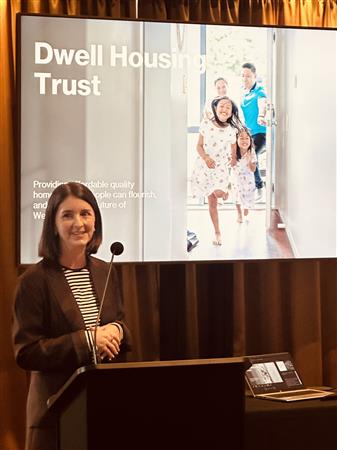
Elizabeth Lester, CEO of Dwell Housing Trust, discussed Dwell's approach to housing vulnerable people, including individuals moved off Wellington's streets. She noted that finding around 30 homes for 35 people took roughly six months, and contrasted this with city council-run community housing, which she said faces greater difficulty managing tenant mix due to them operating at a larger scale.
She described Dwell's deliberate strategy of spreading tenants across ordinary neighbourhoods ("one home here, one home there") rather than concentrating them in large complexes, arguing this avoids the negative effects that can occur when too many high-need tenants are clustered together without the right mix.
In the following Q&A Elizxabeth mentioned that while MCERT manages the waiting list, Dwell's approach is priority need balanced against the need for good neighbourhood mix rather than allocated strictly by vulnerability ranking, and also a location strategy (higher-density housing suits areas with good transit and amenities where tenants are less car-dependent, such as Kilbirnie). Lester also compared Dwell's model with another development, a roughly 36-unit one-bedroom apartment building (referenced near Te Aro/Mahana), which draws from the same waiting list but follows a more concentrated approach.
Lester also acknowledged that current government funding structures tend to favour larger, denser developments to meet urgent housing need, even though she views Dwell's smaller-scale, integrated model as the stronger long-term approach for helping people successfully reintegrate into stable community life. She also drew a comparison to historical state housing policy in New Zealand, which deliberately mixed socioeconomic groups within neighbourhoods.